A Stock Can Fall 70% and Still Not Be Cheap
How to Distinguish a Value Trap From a True Asymmetric Opportunity

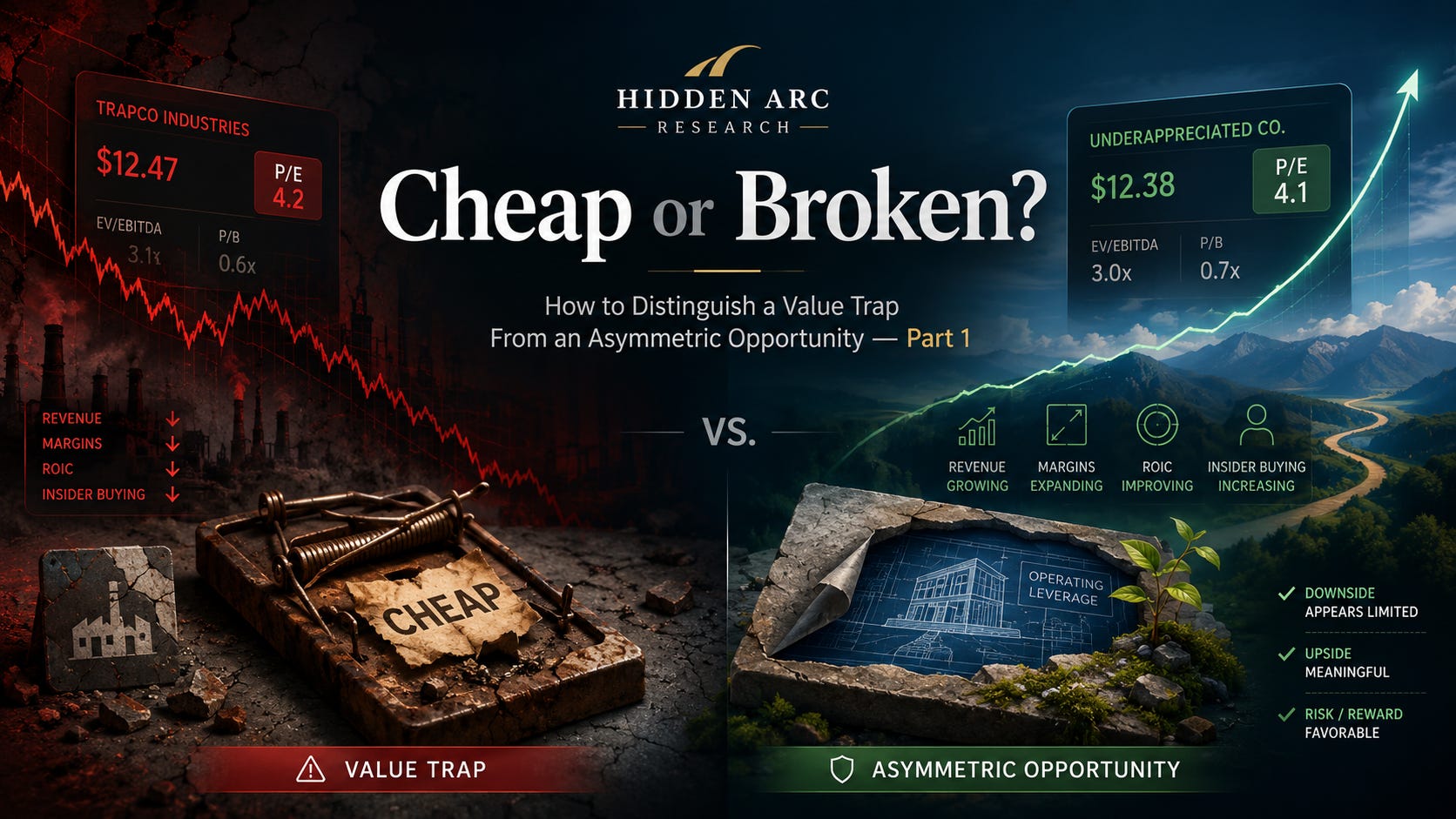
Two companies can look almost identical on a stock screener.
Both may be down 70% from their highs.
Both may trade at five times earnings.
Both may have disappointed investors.
Both may be ignored by Wall Street.
Yet one could continue destroying shareholder value.
The other could become a multi-bagger.
The difficult part is telling them apart.
This is one of the most important skills an investor can develop because the market rarely labels opportunities clearly.
It does not tell you:
“This company is temporarily misunderstood.”
Or:
“This business looks cheap because its economics are permanently deteriorating.”
Both situations usually feel uncomfortable.
Both come with negative headlines.
Both have frustrated shareholders.
Both will have convincing bull and bear arguments.
The difference is not simply whether the stock is cheap.
The difference is why it is cheap—and what is likely to change.
A Low Valuation Is Not an Investment Thesis
Investors often describe a stock as attractive because it trades at:
A low price-to-earnings ratio
A discount to book value
A low revenue multiple
A fraction of its previous share price
A discount to competitors
These facts may tell us where to look.
They do not tell us what to buy.
A company trading at four times earnings could be undervalued.
It could also be accurately pricing earnings that are about to collapse.
A company trading below book value may own valuable assets.
It may also own assets that cannot be sold for anything close to their recorded value.
A stock that has fallen 80% could recover dramatically.
It could also fall another 80%.
Price tells us how the market currently values a business.
It does not tell us whether the market is wrong.
That requires deeper work.
What Is a Value Trap?
A value trap is a company that appears inexpensive based on its current or historical financial results, but whose future business value is deteriorating.
The stock looks cheap because investors are focusing on what the company earned yesterday while underestimating how much it may earn tomorrow.
Common value traps include businesses facing:
Permanent declines in customer demand
Technological disruption
Weakening competitive advantages
Rising debt and interest expenses
Continual shareholder dilution
Deteriorating unit economics
Heavy capital requirements
Management teams that repeatedly miss targets
Earnings that do not convert into cash
A value trap does not always collapse immediately.
That is what makes it dangerous.
The company may continue operating for years. Revenue may remain relatively stable. Management may continue promising a turnaround.
But beneath the surface, the business may be consuming cash, issuing shares, losing relevance or becoming less profitable.
The investor waits for the market to recognize the “value.”
The market waits for the company to prove that the value still exists.
Sometimes, that proof never arrives.
What Is an Asymmetric Opportunity?
An asymmetric opportunity is an investment where the potential upside is significantly larger than the realistic downside.
But asymmetry does not simply mean that a stock could rise a lot.
Almost every speculative company could theoretically increase several hundred percent.
True asymmetry usually contains three elements:
The downside is understandable and survivable.
The market is underestimating a credible path to a much better future.
There are identifiable developments that could close the gap between perception and reality.
The opportunity may exist because the market expects today’s problems to continue indefinitely.
But underneath the surface, something could be changing:
A new product is gaining adoption.
Margins are beginning to expand.
A temporary industry downturn is ending.
A major capital project is reaching completion.
Debt is being refinanced or repaid.
A loss-making segment is being closed.
Customer concentration is declining.
A regulatory change is creating a tailwind.
Operating expenses have stopped rising while revenue continues to grow.
The market often reacts slowly because the historical financial statements still support the old narrative.
That creates the gap.
The financial statements describe the company that existed.
The investor is trying to understand the company that is emerging.
Read more from Hidden Arc Research asymmetric bets


Cheapness Versus Change
The simplest way I distinguish the two is this:
A value trap is cheap because the business is deteriorating faster than the valuation suggests.
An asymmetric opportunity is cheap because the business is improving faster than the market recognizes.
One is anchored to the past.
The other is misprized relative to a changing future.
This is why the direction of the business matters more than the static valuation.
Consider two companies trading at the same earnings multiple.
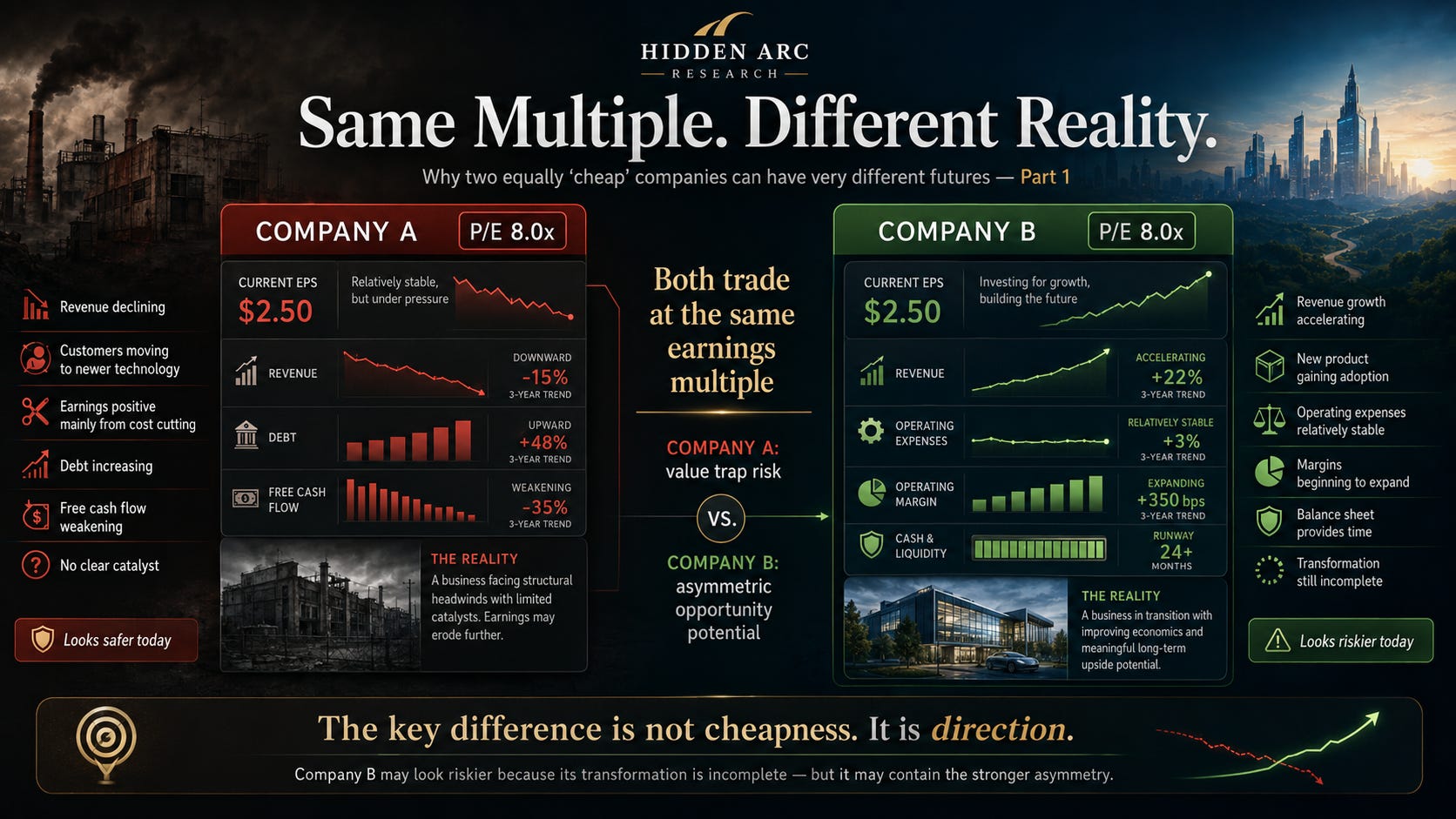
Company A
Revenue is declining.
Customers are moving toward a newer technology.
Earnings remain positive mainly because management is reducing expenses.
Debt is increasing.
Free cash flow is weakening.
There is no clear catalyst beyond management claiming that the stock is undervalued.
Company B
Revenue growth is accelerating.
A recently launched product is gaining adoption.
Operating expenses have remained relatively stable.
Margins are beginning to expand.
The balance sheet provides enough time for the company to reach its next milestone.
Company A may initially look safer because it reports more current earnings.
Company B may look riskier because its transformation is incomplete.
But Company B may contain the stronger asymmetry.
The purpose of research is to determine whether the improvement is real, durable and under appreciated—or merely a convincing story.
Temporary Problems Versus Structural Problems
The first question I ask when studying a cheap company is:
Is the problem temporary or structural?
Temporary problems can create opportunities.
Structural problems can create value traps.
Temporary problems may include:
A short-term inventory correction
A delayed customer contract
A cyclical industry downturn
Temporary cost inflation
A product transition
A regulatory delay
Heavy spending before a new facility begins producing revenue
Structural problems are more serious:
Customers no longer need the product.
A cheaper or better technology has replaced it.
The company has permanently lost its competitive advantage.
Customer acquisition has become uneconomic.
The product has become commoditized.
The entire industry’s economics have weakened.
The question is not whether the company has problems.
Most asymmetric opportunities do.
The question is whether those problems can realistically be solved by the company’s leadership & talent.
A temporarily weak company can recover.
A structurally obsolete company may only become cheaper.
Look for Improving Economics
Revenue growth alone is not enough.
A company can grow while destroying value.
What matters is what happens with each additional dollar of revenue.
I look for evidence such as:
Gross margins stabilizing or improving
Customer retention strengthening
Customer acquisition costs declining
Revenue growing faster than operating expenses
Capital expenditures beginning to normalize
Free cash flow improving
Existing customers spending more over time
One of the most powerful signals is operating leverage.
If revenue is rising while core operating expenses remain relatively stable, more of every incremental dollar can eventually flow toward profit.
That can produce a dramatic change in earnings.
But the opposite is also true.
If a company must continually increase marketing expenses, incentives or capital spending simply to maintain growth, the apparent growth may not create much value for shareholders.
A healthy business should eventually become more economically efficient as it scales.
The Emerging-Business Test
When reviewing a deeply discounted stock, I ask:
Are the company’s current numbers describing its future—or only its past?
This question is especially important when a business is undergoing a genuine transition.
A new product may still represent a small percentage of total revenue.
A high-margin segment may be growing quickly but remain hidden inside a larger, slower business.
A newly completed facility may have required years of spending before producing meaningful cash flow.
These situations can create temporary confusion.
The company may look weak on historical metrics just as its future economics begin to improve.
But investors should be careful.
Management teams understand how attractive a transformation story can sound.
Every struggling company has a plan.
Not every plan is working.
The evidence should appear in measurable results:
Customer adoption
Revenue quality
Margins
Retention
Cash generation
Balance-sheet improvement
An asymmetric opportunity should gradually become less dependent on management’s promises and more supported by reported evidence.
The Central Question
A value trap depends on the past returning.
An asymmetric opportunity is often built around a future that has not yet become obvious.
That does not mean investors should ignore history.
It means history should be used to understand the business—not to assume that old earnings, old valuations or old share prices will automatically return.
The question is not:
“How cheap is the stock compared with where it used to trade?”
It is:
“Is the business becoming stronger or weaker than the current price suggests?”
In Part 2, I will explain the practical framework I use to answer that question, including how I evaluate the balance sheet, cash flow, dilution, catalysts, downside scenarios and the strongest bear case.
Because identifying a potentially mispriced company is only the beginning.
The next step is determining whether shareholders can survive long enough to benefit from it.
What is one stock you believe the market currently views as a value trap—but may actually be an asymmetric opportunity?
I would be interested to hear the case in the comments.
Hidden Arc Research focuses on overlooked public companies, changing business fundamentals and situations where the potential upside may be significantly larger than the realistic downside.
This article is for educational purposes only and should not be considered financial advice. Investors should conduct their own research before making investment decisions.