Before You Buy the Dip, Run These Seven Tests
A Practical Framework for Finding True Asymmetric Opportunities

In my previous article, I explored the central difference between a value trap and an asymmetric opportunity (Here’s the article if you missed it)

A value trap is often cheap because the business is deteriorating faster than the valuation suggests.
An asymmetric opportunity may be cheap because the business is improving faster than the market recognizes.
But identifying signs of improvement is not enough.
A company may possess valuable technology, a growing product and a large addressable market—and still become a poor investment.
The balance sheet may fail.
Shareholders may be diluted.
Reported earnings may never convert into cash.
The catalyst may never arrive.
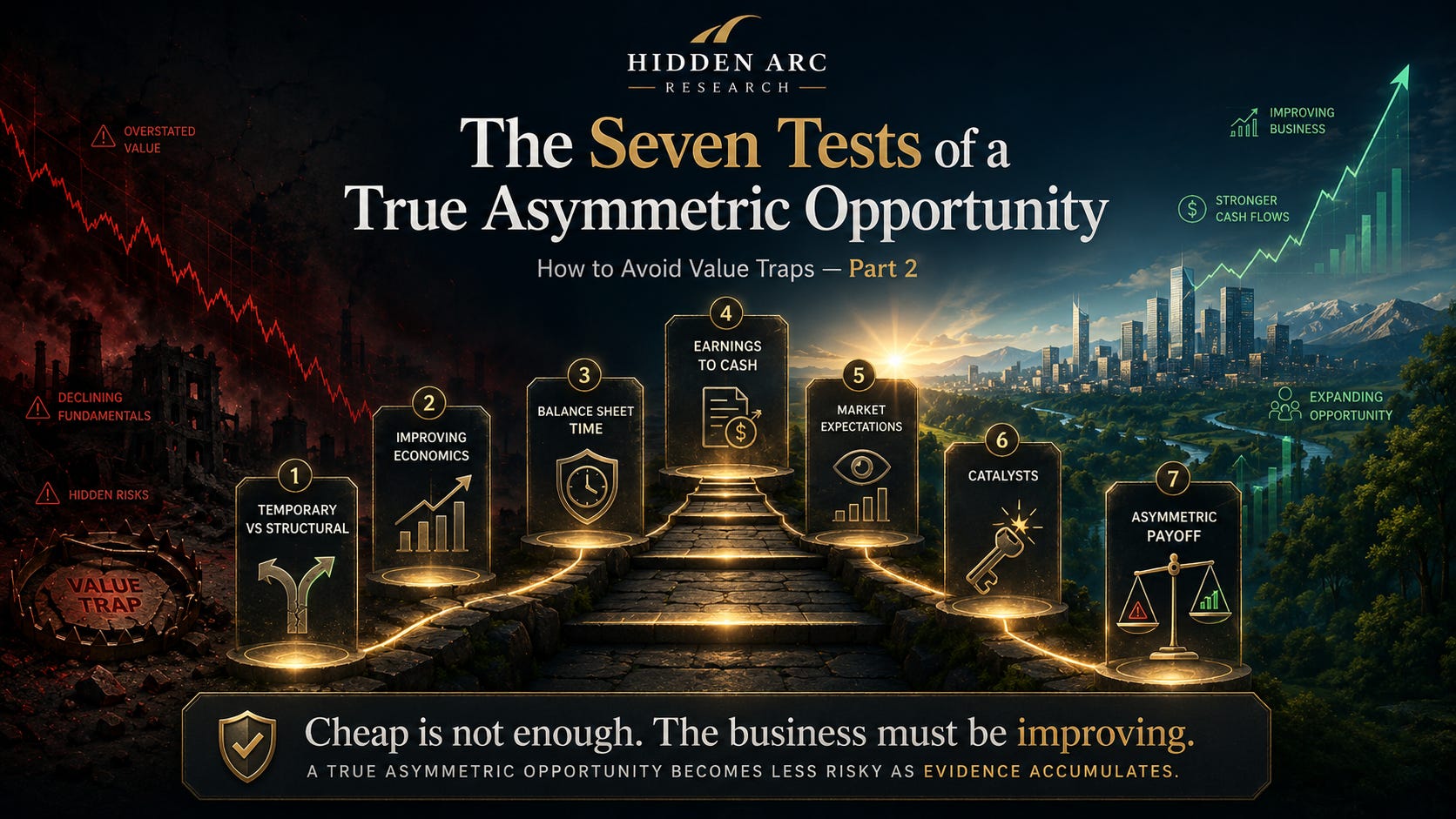
To separate a promising story from a genuine investment opportunity, I use seven practical tests.
Test 1: Is the Problem Temporary or Structural?
The first question is whether the company’s difficulties can realistically be solved.
Temporary problems may include:
A cyclical slowdown
A delayed contract
A product transition
Temporary cost inflation
A regulatory delay
Heavy investment ahead of a launch
Structural problems are much more dangerous:
Permanent demand destruction
Technological obsolescence
Weakening competitive advantages
Commoditization
Uneconomic customer acquisition
An industry with permanently declining returns
Temporary weakness can create mispricing.
Structural decline can make a stock look cheap for years while its intrinsic value continues falling.
Test 2: Are the Economics Improving?
I want to know whether the business is becoming more efficient as it grows.
Useful signals include:
Improving gross margins
Better customer retention
Declining acquisition costs
Revenue growing faster than operating expenses
Improving free cash flow
Higher revenue from existing customers
Lower capital requirements
Revenue growth is valuable only when it eventually produces sustainable cash flow.
Growth that requires increasingly large spending, discounts or incentives may create impressive headlines without creating shareholder value.
Read more from Hidden Arc Research asymmetric bets


Test 3: Does the Balance Sheet Provide Enough Time?
A good business can still become a bad investment if it runs out of money before the thesis develops.
Ask:
How much cash does the company have?
How much cash is it consuming?
When does its debt mature?
Is the debt fixed-rate or floating-rate?
Are there restrictive covenants?
Will the company need to raise capital?
How much dilution could shareholders face?
An asymmetric thesis requires time.
The balance sheet purchases that time.
A company may have excellent technology and strong demand. But if it must repeatedly issue shares at depressed prices, existing shareholders may never receive the full benefit.
The business can succeed while the stock disappoints.
Test 4: Are the Earnings Real?
Reported profits and economic profits are not always the same.
A company can report positive net income while consuming cash.
That does not automatically indicate a problem. Working-capital changes and growth investments can create legitimate differences.
But those differences must be understood.
Look closely at:
Operating cash flow
Free cash flow
Accounts receivable
Inventory
Capitalized costs
Stock-based compensation
Restructuring expenses
One-time gains
Management’s adjusted metrics
The important question is:
Where did the reported profit actually go?
If receivables are increasing, is the company waiting for normal payments—or struggling to collect?
If inventory is rising, is management preparing for real demand—or producing goods that are not selling?
If adjusted earnings are improving, which expenses are excluded?
Adjustments can help clarify underlying performance.
They can also make a weak business appear healthier than it is.
Test 5: What Does the Market Already Believe?
An investment can only be mispriced relative to an existing expectation.
It is not enough to believe that a company will grow.
You need to understand how much growth is already included in the stock price.
Ask:
What does the valuation imply?
What are analysts expecting?
What is management guiding toward?
Which part of the story has the market stopped believing?
What outcome would surprise investors?
Sometimes the opportunity is not that the market expects complete failure.
It may simply expect mediocrity.
The company does not need to become perfect.
It may only need to perform better than the low expectations embedded in the price.
This is why expectations often matter more than headlines.
A company can report poor results and still rise if investors expected something worse.
A company can report excellent results and fall if expectations were even higher.
The correct question is not:
“Is this a good company?”
It is:
“Is the future likely to be better or worse than what today’s valuation assumes?”
Test 6: What Could Change the Narrative?
Being undervalued is not a catalyst.
A company can remain undervalued for many years.
I look for developments that could force investors to reconsider the existing narrative:
A major customer contract
A new product reaching meaningful scale
Positive free cash flow
Debt refinancing
Margin expansion
Asset monetization
A return to revenue growth
Regulatory approval
A strategic partnership
A credible share repurchase
The strongest catalysts improve the company’s actual economics.
A promotional announcement may briefly move the share price.
A contract that generates revenue, improves capacity utilization and validates the product can permanently alter the thesis.
A real catalyst should not merely make the stock more exciting.
It should make the business more valuable.
Test 7: Is the Payoff Truly Asymmetric?
I do not build only one price target.
I build scenarios.
Here is a simplified example:
ScenarioProbabilityPotential returnBear case30%-40%Base case45%+50%Bull case25%+200%
These figures will never be perfectly accurate.
Markets do not follow spreadsheets.
But the exercise forces us to compare the size of the possible reward with the probability and severity of permanent loss.
The surprising feature of asymmetric investing is that investors do not always need to be right most of the time.
Consider a simplified situation:
OutcomeProbabilityReturnThesis fails70%-20%Thesis succeeds30%+100%
The expected return would still be positive:
70% × -20% = -14%
30% × +100% = +30%
Net expected return = +16%
Estimating probabilities is extremely difficult.
But the principle matters.
Investment quality depends on both the probability of success and the size of the payoff.
The essential phrase is limited downside.
Without understandable and survivable downside, it is not asymmetry.
It is speculation.
Five Common Value-Trap Mistakes
1. Assuming a Stock Is Safer Because It Has Fallen
A lower share price may reduce valuation risk.
It does not automatically reduce business risk.
The company’s debt may have risen.
Its competitive position may have weakened.
Its cash runway may have shortened.
The question is not how far the stock has fallen.
It is how much the business has changed.
2. Anchoring to the Previous High
A stock trading at $10 after falling from $50 may appear to have enormous upside.
But the previous price may have been based on unrealistic growth assumptions, unusually low interest rates or temporary market excitement.
The old share price is not evidence of intrinsic value.
A stock does not remember where it used to trade.
3. Treating All Cash as Excess Cash
Investors sometimes subtract the entire cash balance from a company’s market capitalization and conclude that the operating business is almost free.
But that cash may be needed for:
Working capital
Debt repayments
Capital expenditures
Regulatory requirements
Customer commitments
Ongoing operating losses
The important figure is not total cash.
It is the cash that remains after the business funds its obligations.
4. Ignoring Dilution
A company can increase in total value while creating little value per share.
This happens when new shares are repeatedly issued to employees, lenders or investors.
Always examine the fully diluted share count.
Shareholders benefit from value created per share, not simply from the company becoming larger.
5. Falling in Love With the Bull Case
A compelling narrative can make contradictory evidence easy to ignore.
This is especially dangerous when the company is associated with an exciting theme such as artificial intelligence, biotechnology, renewable energy or financial disruption.
The theme may be correct.
The company may still fail.
A growing industry does not guarantee that every participant will create shareholder value.
The Strongest Bear Case Is Not Always Bankruptcy
Investors often imagine the bear case as a dramatic collapse.
But a more common risk is that the business remains strong enough to survive and too weak to create meaningful value.
Revenue grows slowly.
Margins improve slightly.
Management continues promising that the inflection point is one quarter away.
The company periodically issues shares.
The stock occasionally rallies and then falls back.
Years pass.
The investor’s capital remains trapped while better opportunities are missed.
Time is a real cost.
A stock does not need to go to zero to become a poor investment.
Build the Bear Case Before the Bull Case
Before becoming excited about an opportunity, I try to answer:
What is the strongest argument against the investment?
Which assumption is most likely to be wrong?
What could permanently damage the business?
What could force the company to issue shares?
Which metric would reveal that the thesis is weakening?
What evidence would make me exit?
Do management’s explanations match the financial statements?
A weak bear case sounds like:
“The economy could slow down.”
A useful bear case attacks the engine of the thesis:
“The new product may be growing only because the company is using uneconomic incentives. If customer acquisition costs remain high and retention weakens, revenue growth may not produce sustainable cash flow.”
The more specific the bear case, the more useful it becomes.
The goal is not to eliminate uncertainty.
The goal is to identify which uncertainties matter most.
The Final Checklist
Before investing in a deeply discounted company, ask:
The business
Is customer demand stable or growing?
Is the problem temporary or structural?
Does the company possess a real competitive advantage?
Are the underlying economics improving?
The finances
Do earnings convert into cash?
Is debt manageable?
Does the balance sheet provide sufficient time?
Is significant dilution likely?
How much cash is genuinely available?
The thesis
What does the market currently expect?
What evidence suggests those expectations are too pessimistic?
What milestones can be measured each quarter?
What would prove the thesis wrong?
What catalyst could change the narrative?
The asymmetry
What is the realistic downside?
Can the company survive the bear case?
What is the probable base-case return?
What could create the bull case?
Is the potential upside large enough to justify the uncertainty?
The more vague the answers, the weaker the opportunity.
The Final Distinction
A value trap asks you to believe that cheapness alone will eventually be rewarded.
An asymmetric opportunity gives you evidence that the underlying economics are moving in the right direction.
A value trap becomes cheaper as the thesis deteriorates.
An asymmetric opportunity becomes less risky as the evidence accumulates.
That is what I am ultimately looking for.
Not simply a low valuation.
Not simply a stock that has fallen.
Not simply an exciting story with enormous theoretical upside.
I am looking for a situation where expectations are unusually low, the business is beginning to move in a different direction, the balance sheet provides enough time, and the potential upside meaningfully outweighs the possibility of permanent loss.
Those opportunities are rare.
They are often uncomfortable.
And they almost never look obvious at the beginning.
That is precisely why they can be so rewarding.
I would love to hear from you. What did you think about this article? Leave your thoughts below, and Ill respond back :)
Hidden Arc Research focuses on overlooked public companies, changing business fundamentals and situations where the potential upside may be significantly larger than the realistic downside.
This article is for educational purposes only and should not be considered financial advice. Investors should conduct their own research before making investment decisions.